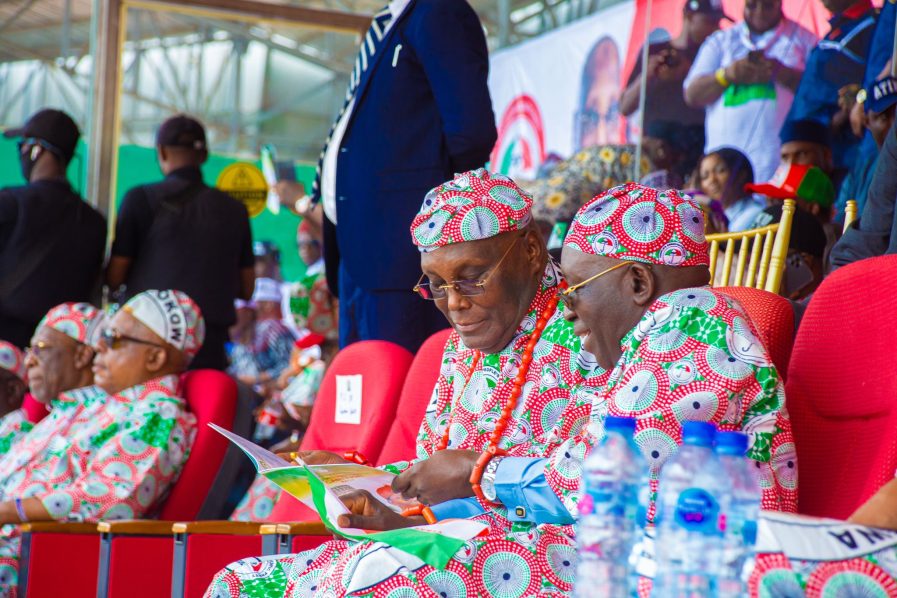
The PDP’s Struggle and the Path Forward
Former President of the Senate, Dr. Bukola Saraki has remained a pivotal figure in Nigerian politics, especially within the People’s Democratic Party (PDP). His decision to remain loyal to the PDP despite many of his close allies switching to other parties has sparked considerable debate. In an exclusive interview with our correspondents, he provides insights into his motivations, the challenges facing the party, and his vision for the future.
Staying Loyal to the PDP
Dr. Saraki emphasized that his commitment to the PDP is not driven by personal loyalty to any individual, but rather by the party’s potential to provide a platform for political contestation. He explained:
“The only objective I have and I’m still appealing to a lot of PDP members is, let us not look at the party through the mirror of whether it’s Tanimu, Wike, Sam Anyanwu, Damagun, Makinde or Bala. Let us look at our objective. Does it create an opportunity for PDP to present candidates? If it does, that’s where we should all be.”
He acknowledged that there are personal differences among leaders, but stressed that these should not overshadow the party’s broader goals. He also warned that those who currently oppose the party may change their stance in the near future.
The Role of INEC in the PDP Convention
A key concern raised by Dr. Saraki was the role of the Independent National Electoral Commission (INEC) during the PDP convention. He expressed skepticism about whether INEC would be present at the upcoming Abuja convention, given Taminu Turaki’s claim that they had gone to the Supreme Court. However, he remains optimistic about the possibility of the PDP being recognized by INEC, which could enable its members to contest elections.
The Future of the PDP
Dr. Saraki believes the PDP still has a fighting chance. Despite losing several governors and senators, he notes that some former members have returned to the party, such as David Ombugadu in Nasarawa. He argues that the party’s strength lies in its ability to provide a platform for aspiring politicians, regardless of their personal connections.
“They want to contest election. They’re not interested in Saraki, Makinde, Wike. No, they just want a platform they can contest election. I mean, you might be more interested in that, because of your readers, but for those who are at the grassroots, that’s what they’re interested in.”
He also highlighted the importance of resolving internal conflicts within the PDP to restore confidence among its members.
Zoning and Leadership
One of the central issues discussed was the zoning of leadership positions within the PDP. Dr. Saraki reiterated his support for the agreement that the chairmanship should be zoned to the North Central region. He criticized the current leadership for deviating from this arrangement and called for a return to the original understanding.
“That’s where I am 100% on that position, because there was an agreement. If you remember, it was Ayu that emerged as the chairman with the zoning, and the deputy position went to North East. Ayu left.”
He emphasized that maintaining this agreement is crucial for the party’s unity and long-term success.
Presidential Ambitions and the 2027 Election
When asked about his own presidential ambitions, Dr. Saraki stated that he will not contest in 2027, believing that the South should have its turn first. He argued that this would ensure clarity for the 2031 election, when the North could take over.
“I am not contesting in 2027 because I believe that it’s only fair. The South came in 2023. Let them finish in 2027. So that in 2031, there’s no ambiguity for those of us that come from the North.”
He clarified that his decision is not an endorsement of President Bola Tinubu, but rather a strategic move to avoid confusion in the future.
Institutional Weaknesses and the Need for Reform
Dr. Saraki also spoke about the weaknesses of Nigeria’s institutions, particularly the National Assembly and the electoral process. He argued that these institutions must be strengthened to ensure credible elections and effective governance.
“Changing a government in a developing democracy is not easy. The reason what makes the difference between them and us are the institutions.”
He pointed to the need for reforms in the Electoral Act and the importance of ensuring that the voices of ordinary citizens are heard.
A Call for Unity and Reconciliation
Despite the challenges, Dr. Saraki remains hopeful that the PDP can recover and regain its footing. He has been actively facilitating meetings between different factions of the party to promote reconciliation and unity.
“I don’t think this reconciliation is something that can start and finish. It should be continuous. I think sentiments and emotions will begin to come down a bit. Options and reality will set in, and it will be easier.”
He believes that with the right leadership and institutional reforms, the PDP can once again become a viable political force in Nigeria.
Conclusion
Dr. Saraki’s unwavering commitment to the PDP reflects his belief in the party’s potential to serve as a platform for political contestation and national development. While the road ahead is fraught with challenges, he remains optimistic that with unity, reform, and strategic leadership, the PDP can reclaim its place as a major political force in Nigeria.