Marco Polo, the renowned Venetian explorer of the 13th century, documented his travels in Sumatra, Indonesia, in his autobiographical work, The Travels of Marco Polo. He noted the presence of “wild elephants in the country”, and what he described as “numerous unicorns, which are very nearly as big. They have hair like that of a buffalo, feet like those of an elephant, and a horn in the middle of the forehead, which is black and very thick.” While it’s clear today that Polo was likely encountering rhinoceroses, it’s crucial to understand that for medieval Europeans, unicorns were not considered mythical beasts but rather a zoological certainty.
The Enduring Allure of the Unicorn in Medieval Art
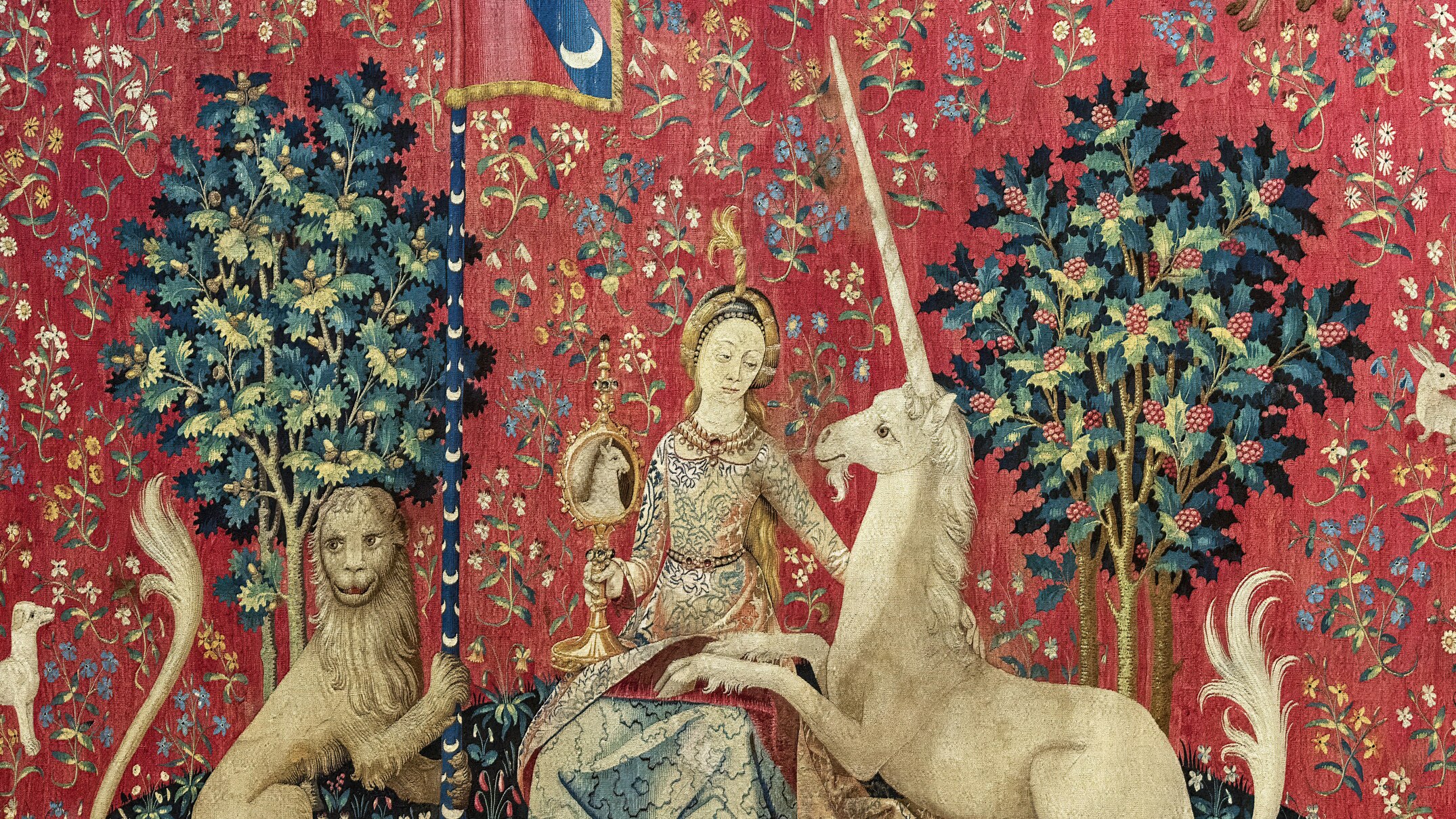
The image of the unicorn permeates medieval art, with one of the most celebrated examples being the series of tapestries known as The Lady and the Unicorn. These exquisite works, currently housed at the Musée Cluny in Paris, possess an intriguing, albeit unexpected, connection to a treasured manuscript held in Melbourne.
The Cluny tapestries have been a subject of scholarly discussion and admiration since their acquisition by the museum in 1882. Woven from wool and silk around the year 1500, they represent a rare and remarkably preserved example of a delicate and exceptionally costly art form. Even without the historical enigmas they present, their artistic merit alone would secure their status as masterpieces.
Each of the six tapestries depicts an elegantly attired lady, adorned with fine clothing and exquisite jewellery, accompanied by a radiant white unicorn. Art historians widely concur that five of these tapestries symbolically represent the five traditional senses: smell, taste, touch, sight, and sound.
- Touch: In this scene, the lady is shown accepting small sugared confections from a servant.
- Sound: Here, the lady is depicted playing a musical organ.
- Sight: This tapestry portrays the lady holding a mirror for the unicorn, which gazes at its own reflection, gently resting in her lap.
However, the sixth tapestry introduces an element that disrupts this otherwise neat allegorical framework.
Unravelling the Mystery of “À Mon Seul Désir”
The largest and final tapestry in the series presents the same lady within the ornate canopy of an elaborate tent. Inscribed upon this tent is a cryptic motto: “À Mon Seul Désir,” which translates to “To my heart’s desire.” Beneath this inscription, the lady is shown divesting herself of her jewels, placing them into a chest, while a lion and a unicorn, both bearing standards, observe the scene.
This final tapestry has invited a multitude of interpretations. It may signify a dedication to the intended recipient of the tapestries, a declaration of love, a commemoration of a marriage, or perhaps it represents a “sixth sense” – a higher form of perception where worldly possessions and pleasures are renounced in favour of fulfilling one’s deepest, most genuine desires.
Yet, further insights into the intended meaning of these tapestries can be found in the richly illuminated medieval manuscripts that have been preserved, many of which, surprisingly, reside within Australia’s public collections.
The Wharncliffe Hours: A Mirror to the Tapestries
One such magnificently decorated manuscript is the Wharncliffe Hours. This 15th-century French “book of hours,” essentially a prayer book, was the first manuscript acquired by the National Gallery of Victoria, purchased at auction in 1920. It is replete with psalms, prayers, Gospel narratives, and a calendar of significant Christian feast days.
Within its pages, a particular scene will resonate with anyone familiar with the celebrated Cluny tapestries. Much like in the tapestries, this illuminated page features a finely dressed woman with a unicorn resting in her lap, seemingly captivated by its own reflection in a mirror.
While this scene might appear to be a straightforward allegory for “Sight,” it carries a far more profound and layered meaning. This depiction is known as the “entrapment of the unicorn,” a popular motif in medieval art.
Medieval lore posited the unicorn as a potent and formidable creature whose horn was believed to possess antidotal properties capable of neutralising poisons. However, the legend held that only a virgin woman, due to her inherent purity, possessed the spiritual fortitude to coax this wild beast into submission.
Multiple Readings of the Unicorn Narrative
By the 15th century, this narrative had evolved into “the hunt of the unicorn.” Tales emerged of elaborate hunting parties, complete with hounds and spears, employing a chaste virgin to capture and ultimately slay the mythical creature.
Beyond its function as a chivalric narrative reflecting 15th-century European courtly hunting culture, the story of the unicorn’s entrapment also offers a window into late-medieval perspectives on gender and sexuality. The supposed purity of the virgin who captured the unicorn was not only linked to the immaculate conception of the Virgin Mary but also served as a cautionary tale for men, highlighting the perceived duplicity of women and their capacity to “entrap” them.
The other scenes adorning the margins of the Wharncliffe Hours further illuminate the depth of this concept. In the upper right corner of the same page, another woman is depicted, mirroring the virgin below. However, this figure is Delilah, and instead of a unicorn, she cradles Samson in her lap.
The Old Testament narrative of Samson and Delilah recounts how the prostitute entraps Samson by cutting his hair, thereby severing his divine vow as a Nazarite. The illustrators of the Wharncliffe Hours deliberately juxtaposed these two stories – the capture of the unicorn and the tale of Samson and Delilah – on a single page. This visual pairing was intended to prompt contemplation on the virtues of chaste women and the perils of female deception and entrapment.
Consequently, a series of tapestries commonly interpreted as explorations of love, devotion, and marriage carries a significant caveat: the women deserving of praise and veneration are those who maintain their chastity and purity. The Lady and the Unicorn serves not only as a reminder of some of the more unsettling historical perspectives on female sexuality that have been passed down through generations but also encourages us to recognise that all art, whether ancient or contemporary, is imbued with a multiplicity of meanings.